The fold-and-store approach feels responsible. The show is over, the costumes come back, they get hung up or folded into a box or bag, and the lid goes on until next time. Job done. Costumes safe.
What's actually happening inside that box is considerably less straightforward – and for anyone responsible for garments that will be worn against skin, often by children, it's worth understanding in some detail.
Dust mites: the basics, and why they matter
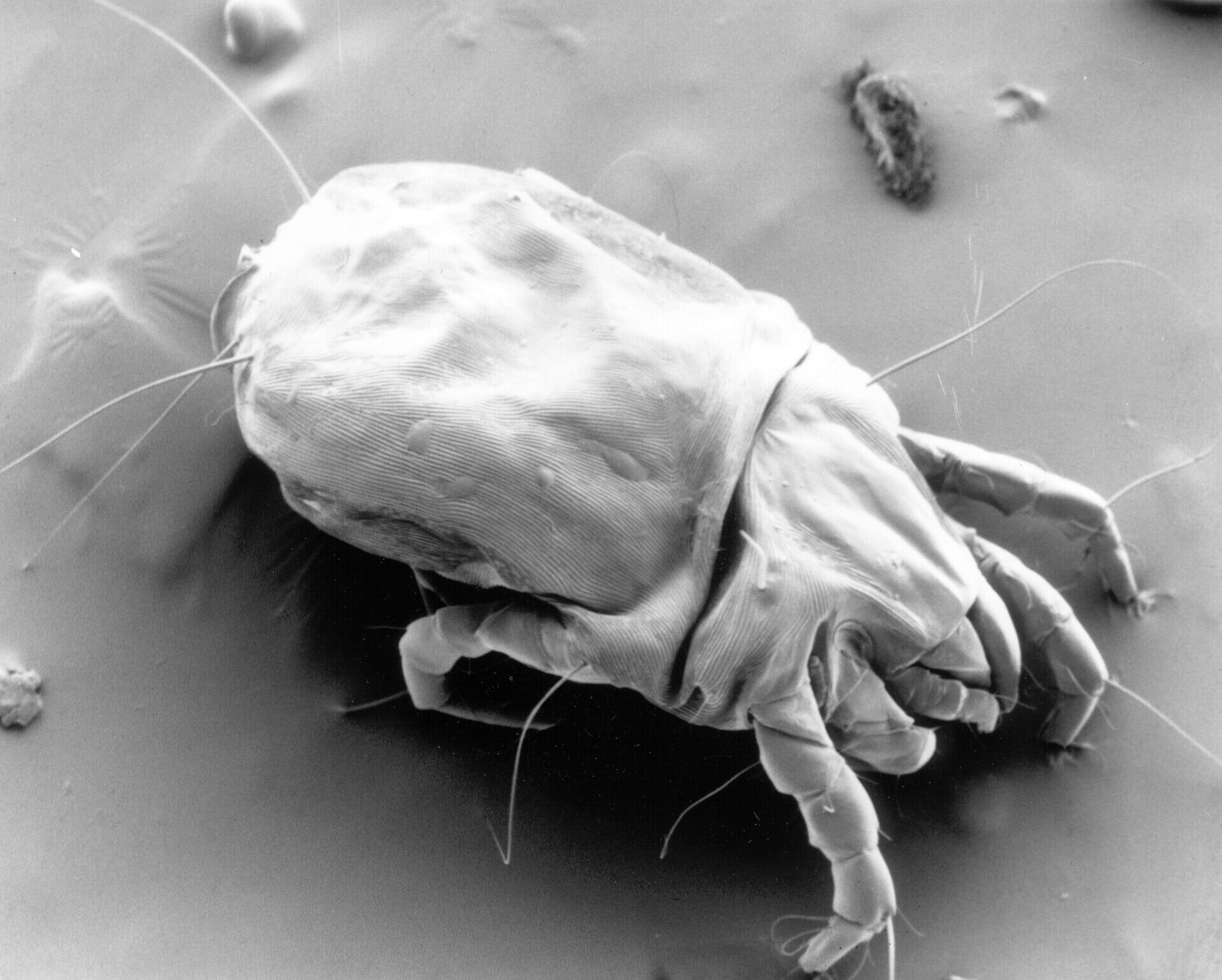
House dust mites are microscopic arachnids – eight-legged, related to spiders and ticks, invisible to the naked eye. The dominant UK species is Dermatophagoides pteronyssinus, though D. farinae and several others are also present in domestic and storage environments. They're not parasites – they don't bite, feed on blood, or burrow into skin. What they do is live in fabric, in large numbers, and produce the substance that causes the problems.
The allergenic material produced by dust mites is not the mites themselves. It's their faecal pellets and, to a lesser extent, their shed body fragments after death. A single dust mite produces around 20 faecal pellets per day. Those pellets contain proteins (principally the enzymes Der p 1 and Der p 2) that are potent allergens for a significant proportion of the population.
Der p 1 is a cysteine protease: an enzyme capable of cleaving proteins, including the tight junction proteins in the epithelial lining of the respiratory tract. This is part of why dust mite allergen is so effective at triggering an immune response – it actively degrades the physical barrier that would otherwise prevent allergen penetration into tissue.
In the UK, sensitivity to house dust mite allergen is estimated to affect around 45 – 85% of people with asthma, and a substantial proportion of people with allergic rhinitis. It's one of the most common indoor allergens, and one of the most clinically significant.
What dust mites need to thrive
Dust mites have specific environmental requirements, and stored textiles meet almost all of them.
Temperature: they prefer 17 – 25°C, though they survive across a wider range. A box stored in a heated building, or in a garage or outbuilding that doesn't get cold enough to kill them, is within their comfort zone for most of the year.
Humidity: this is the critical variable. Dust mites are hygroscopic – they absorb water vapour directly from the air through their bodies. They cannot survive in environments where the relative humidity drops consistently below around 40 – 50%. Above that threshold, they thrive. UK indoor environments, particularly during winter with central heating, tend to sit at 40 – 60% relative humidity – close to or within the range where mites are active and reproducing.
Food: dust mites feed primarily on shed human skin cells – dander. A costume worn against skin for an hour is carrying significant quantities of skin cells in its fibres. A costume that's been worn repeatedly over a show season is carrying several hours' worth. That's a substantial food source being folded into a box and sealed.
Darkness and lack of disturbance: dust mites don't do well with UV exposure, heat, or physical disruption. A sealed box in a dark cupboard is ideal habitat.
The population dynamics of a stored costume
Dust mite populations can reach significant densities quickly under favourable conditions. Research has recorded densities of several hundred to several thousand mites per gram of fabric in heavily colonised textiles – figures that are frequently cited in relation to mattresses and soft furnishings, but equally applicable to stored garments with similar properties.
At those densities, the quantity of faecal allergen present in a garment is clinically meaningful. When the costume is next removed, shaken out, and put on (particularly against the skin, in the warm environment of a dressing room) that allergen becomes airborne.
For a child with undiagnosed or poorly controlled allergic disease, or for a teacher or performer with dust mite sensitivity, this is not a theoretical risk. It's a direct allergen exposure event that could trigger rhinitis, urticaria, or asthma symptoms.
Most people, experiencing a runny nose or itchy skin during a show, would not connect it to what was living in the costume.
Mould and mildew: the other occupant
Dust mites are not the only biological risk in stored textiles. Mould and mildew are fungal organisms that colonise fabric under conditions of sufficient humidity, and they are frequently present alongside dust mite populations in stored costume collections.
The species most commonly found in indoor fabric environments include Cladosporium, Aspergillus, and Penicillium – all capable of producing spores that become airborne when disturbed, and all documented as allergens and, in some cases, respiratory irritants.
Mould colonisation in fabric isn't always visible. Early-stage growth can be present in the fibre structure of a garment without producing the visible dark spotting most people associate with mould. A costume that smells musty (that particular stale, earthy smell that stored fabric develops) is already carrying mould growth. The smell is produced by volatile organic compounds (VOCs) emitted by fungal organisms as metabolic byproducts.
By the time mould is visible on fabric, it has typically been present and growing for some time. Surface spotting represents established colonisation – not the beginning of the problem.
The fold-and-store problem, specifically
The storage approach most commonly used for costumes – folding into boxes, hanging in bags, stacking in storage rooms – creates near-ideal conditions for both dust mites and mould.
Folding concentrates the fabric in on itself. Creases trap moisture. Stacked or tightly folded garments have limited airflow across their surface area, meaning humidity can build within the fold rather than dissipating. A garment stored in a sealed plastic bag is in some ways more problematic than one stored in a cardboard box, because plastic is impermeable – any residual moisture from the garment, or absorbed from the air before sealing, stays inside the bag and cannot escape.
Breathable fabric storage bags slow the problem rather than solve it. They allow some airflow, which is better than none – but they don't address the underlying biology if the garment itself is carrying the food source (skin cells) that mites require.
Why surface treatment doesn't fix this
Some people address stored-costume hygiene with surface sprays – fabric fresheners, anti-bacterial sprays, essential-oil-based products marketed for textile use. These are not solutions to dust mite or mould contamination.
Fabric fresheners mask odour. They don't penetrate the fibre structure of the garment, don't remove biological matter, and have no meaningful impact on mite populations or mould colonisation. Anti-bacterial sprays address bacteria, not mites or fungal organisms. Even products with some genuine anti-mould properties work on surface growth, not on the conditions that produce it.
Killing dust mites reliably requires sustained heat – 60°C for a minimum of 30 minutes, according to the evidence base used by the British Society for Allergy and Clinical Immunology. That temperature will damage or destroy most specialist performance fabrics, which rules it out as a practical option for costume care.
Cold is partially effective (temperatures below -17°C for 24 hours or more will kill mites) but won't remove the allergen already present in the faecal matter and body fragments that remain in the fabric. Killing the population doesn't clean the garment.
The only approach that genuinely addresses both mites and mould is thorough washing of the garment detergents capable of removing biological matter and allergen proteins – combined with complete, controlled drying before storage.
What complete drying actually means
Incomplete drying before storage is one of the most common contributing factors to mould colonisation in stored textiles. A garment that's been washed but stored while still retaining even small amounts of moisture will develop mould growth in storage – sometimes within days, depending on ambient conditions.
Domestic drying environments (airing cupboards, radiators, cool tumble dryers) frequently leave garments feeling dry at the surface while retaining moisture deeper in thicker fabric layers, linings, and structural elements. That residual moisture is enough to support mould growth in a sealed or low-airflow storage environment.
Professional wet cleaning facilities dry garments in controlled conditions: temperature, airflow, and timing managed to achieve complete moisture removal before the garment is finished. It's the step that determines whether the clean provides lasting protection or just resets the clock.
The interval question
Even costumes that have been properly cleaned accumulate biological material during use – every performance deposits skin cells, sweat, and organic material into the fabric. The question of how often a costume needs professional cleaning is partly a function of how often it's worn, and partly of how it's stored between seasons.
A costume worn for a single show season and then stored for six to eight months has a lengthy period during which any residual organic material can support mite and mould activity. End-of-season cleaning (before long-term storage, not before the next use) is the interval that matters most.
Most people do the opposite: clean before the show, store at the end of it. The show is the event they're preparing for. The storage is the thing that follows. But from a biological standpoint, the storage period is where the problem compounds – and cleaning before it starts is what prevents that.
A note on sources: The allergen data in this piece draws on published research from the British Society for Allergy and Clinical Immunology, the European Academy of Allergy and Clinical Immunology, and peer-reviewed work on textile microbiology. Dust mite population figures vary considerably by study — the ranges cited here reflect published research rather than worst-case estimates.